
There is a particular kind of early romance in which a person becomes a story before we know them very well. A few messages suggest a temperament. A good evening becomes evidence of destiny. We supply the missing chapters with astonishing confidence.
Greek mythology love stories know something about that confidence. Their lovers cross seas, challenge death and mistake beauty for an answer. They also make promises, keep secrets and discover that being wanted can feel very different from being known. The scenery has changed. Some of the questions have survived.
Four tales offer especially rich company for thinking about dating: Eros and Psyche, Orpheus and Eurydice, Theseus and Ariadne, and Echo and Narcissus. Read them closely and the familiar romance begins to look less settled. Whose trust matters? Who does the work? What happens when the beloved refuses the role we have written?
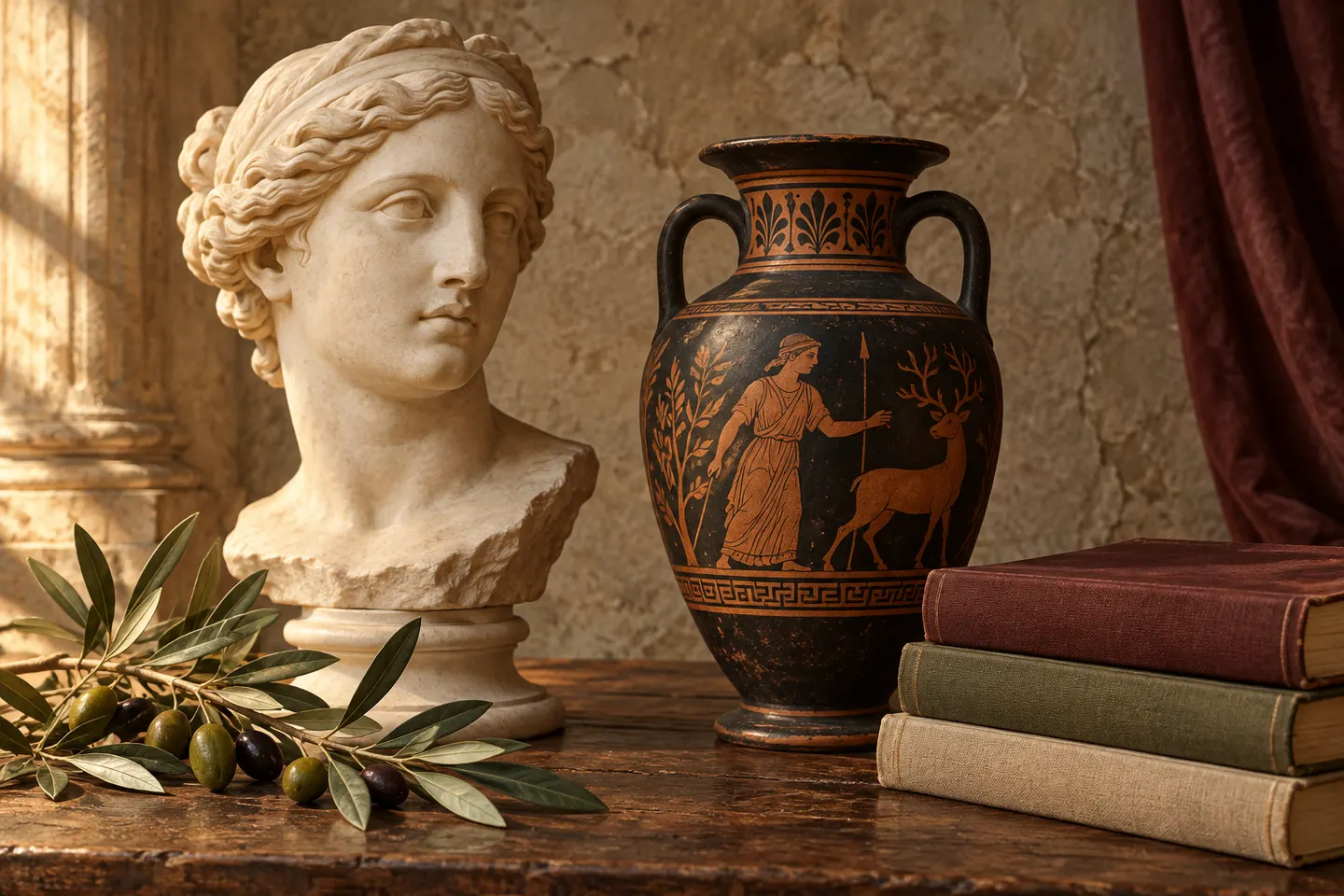
Reading love in Greek mythology with modern eyes
Ancient Greece was not a single voice, and Greek mythology is not a single book. Stories changed with the teller. Several versions familiar today survive in Roman literature: Ovid's Metamorphoses and Apuleius's The Golden Ass are important examples. Their gods sometimes wear Latin names. Eros becomes Cupid; Aphrodite becomes Venus.
That matters when we look for lessons. A Greek myth can reveal a troubling question without offering an admirable answer. Gods and mortals do not meet as equals, and beautiful language can surround acts we would rightly reject. We can enjoy the art while questioning the bargain.
The reflections below are modern readings of these love stories. They are an invitation to notice our own expectations, with enough distance to smile at them and enough attention to change them.
Eros and Psyche: when mystery becomes secrecy
Psyche is a king's daughter whose beauty attracts honors that provoke the goddess Aphrodite. In Apuleius's tale of Cupid and Psyche, Venus sends her son Cupid to punish the young woman through love. Instead, the god falls in love with her himself. Psyche lives in a wonderful palace, but her husband visits at night and conceals his identity.
Prompted by her sisters' warnings, Psyche lights a lamp while he sleeps. She discovers the god, spills hot oil and loses him. A series of harsh tasks imposed by Venus follows, including a journey to the underworld. Eventually Psyche becomes immortal and the lovers are reunited.
Trust needs something to stand on
It is tempting to read this as a warning against curiosity: Psyche had happiness until she asked to see it clearly. Yet the arrangement deserves a question of its own. Why must one person remain in darkness for the relationship to survive?
Eros asks for trust while controlling the terms on which Psyche can know him. To a modern reader, that is a difficult foundation. Mystery may lend charm to a first meeting. By the fifth unexplained disappearance, charm has quite a workload.
The dating lesson I take from this story is that trust grows through what two people are willing to make clear. You can respect someone's privacy while asking whether they are available, what they want and whether their actions fit their words. Neither a casual connection nor a lasting partnership requires you to accept permanent confusion.
Psyche's courage also deserves attention beyond her wish to recover a husband. She acts, searches and persists. We can admire that resolve without turning her suffering into an entrance fee for love. Devotion becomes a poor bargain when only one person must prove it.
Orpheus and Eurydice: the limits of a grand gesture
In Ovid's account of Orpheus and Eurydice, a venomous snake kills the musician's wife soon after their wedding. Orpheus enters the underworld and sings before its king and queen. His appeal moves the rulers of the dead, who permit Eurydice to return on one condition: he must not look back at her before leaving.
Near the upper world, fear and longing overcome him. He turns. Eurydice slips away again. The story makes an almost unbearable contrast between the scale of his achievement and the small movement that undoes it.
Love cannot remove every uncertainty
This is one of Greek mythology's most tragic love stories, and its grief deserves more care than a slogan about trust. Eurydice has died; Orpheus is not simply being impatient. Nor does the tale establish that asking a partner for reassurance is a mistake.
What it offers instead is an image of the wish to make love certain. Orpheus can move the underworld with his art, but he cannot bear the final stretch without evidence. The extraordinary musician is still a frightened human being.
Modern romance gives us less dramatic versions of that wish. We may believe that one perfect confession will settle everything, or that enough effort will guarantee the answer we want. A grand gesture can express a feeling. It cannot decide how another person feels, and it cannot make a relationship safe from change forever.
There is tenderness in recognizing that limit. We can ask clear questions, listen to the answers and honor the commitments we make. We can also leave room for what remains unknown. The alternative is to spend every pleasant evening checking whether it will last, until the checking becomes the evening.
Orpheus's devotion is moving because it is vulnerable. In our own life, we might let vulnerability become a conversation before it becomes a performance.
Theseus and Ariadne: who holds the thread?
Ariadne helps Theseus escape the Labyrinth after he kills the Minotaur. The thread she supplies allows him to find his way back. They leave Crete together, but their story does not settle into a simple marriage plot.
Plutarch records conflicting accounts of Ariadne's fate, including abandonment for another woman and separation caused by a storm. Other traditions connect her with Dionysus. There is no single ending that tidies away every contradiction.
Being needed is not the same as being cherished
In the abandonment versions, the uncomfortable fact is how much the hero owes to someone his onward journey leaves behind. The person holding the thread makes the adventure possible. The applause tends to follow the person holding the sword.
That imbalance gives this tale its modern sting. Consider the early relationship in which one person arranges every meeting, makes every journey and provides comfort through every crisis. Being indispensable can resemble intimacy. It can also hide the absence of mutual care.
The question is not whether every favor receives an equal favor. Affection would become unbearable if we issued receipts. The question is whether both people have room to need things. Can you ask for help? Can you disappoint them without becoming disposable? Is their interest still present when you have nothing immediate to provide?
Ariadne also complicates the heroic stories we tell about ourselves. When we describe how we fell in love, whose effort gets a sentence? Who changed plans, crossed the city or made the difficult introduction? To honor that work is to notice the person doing it.
A useful reflection here is to consider the last three times you met. Who made them happen, and how did each person show care? The answer may reveal more than the grandest promise. A thread is a small thing, until you need to get home.
Echo and Narcissus: unrequited love and the imagined beloved
In Ovid's story of Echo and Narcissus, Echo can only repeat the closing words of other people's speech. She falls in love with Narcissus, who rejects her. Later, he becomes absorbed by his own reflection in a pool, initially mistaking it for someone else. He cannot reach the figure he desires and wastes away. Echo, too, dwindles until her voice remains.
Make room for a person who can surprise you
These two lovers never form a couple. Their desires turn toward someone who cannot, or will not, answer as they hope. That distinction matters: unrequited love does not become a relationship through the strength of one person's feeling.
The pool offers a sharp image for projection. We meet someone attractive and begin to furnish the rest: their kindness, their taste, the future weekend away. There may be little evidence beyond beauty and a shared enthusiasm for one obscure novel. We have fallen for a promising first paragraph and quietly supplied the entire book.
Dating asks for the patience to discover where the real person differs from the imagined one. They may want less commitment, more time alone or a life that does not fit our plans. Their difference deserves to be heard. It is not a flaw in the casting.
Echo's predicament invites another question. How much of yourself remains audible when you want someone to like you? Agreeing with every opinion may keep a conversation smooth, but it gives the other person very little chance to know you.
This story is not a diagnosis for a disappointing date. Its value lies in the attention it asks of us: listen for a separate voice, and allow yourself one. Being met requires more than being mirrored.
What these love stories leave us with
Greek mythology gives desire a magnificent stage. For everyday romance, the useful questions are often quiet. Can I ask for clarity? Does care travel in both directions? Am I meeting this person, or defending my idea of them?
Those questions belong to casual dating as much as to the hope of finding a partner for life. Two people can want an evening together without promising forever. What matters is that neither is forced to guess the agreement. Passion and plain speaking can share a table.
If you want to spend more time with these tales, our guide to Greek mythology books offers routes through ancient poetry, broad introductions and modern retellings. A different narrator may change where your sympathy falls.
Perhaps that is the most useful habit these old love stories encourage: look again, especially at the person the hero has overlooked. In romance, as in reading, a little less certainty can make room for a great deal more attention.